
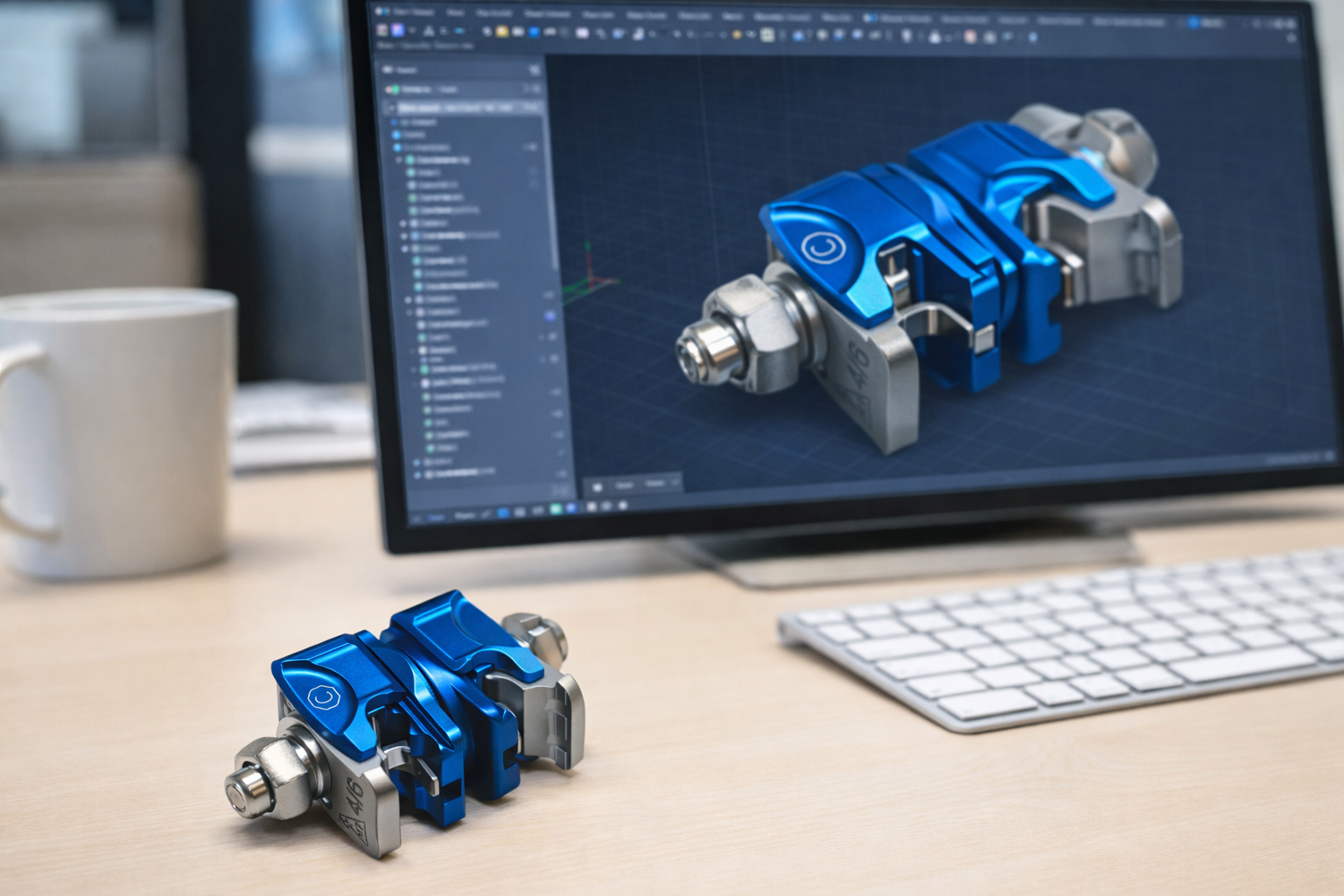
Medical device components rarely stay “simple” for long. A part that looks straightforward on a drawing can become complex once you add critical sealing surfaces, miniature features, tight alignment requirements, aesthetic zones, and documentation expectations. And when that complexity spans multiple manufacturing steps, the biggest risk often isn’t any single process – it’s the handoff between suppliers.
When multiple vendors each own one slice of the build, small interpretation differences can compound into late-stage failures: assemblies that don’t align, seals that don’t hold, or dimensions that drift just enough to create functional variability. Integrated manufacturing reduces those risks by treating the part like a system from day one-because what happens in process #1 directly influences success in process #2.
The hidden cost of supplier handoffs in medical device programs
Splitting a build across multiple suppliers can look efficient on paper. In practice, each handoff adds friction and variability that show up as quality issues, schedule slips, or unexpected rework.
Quality drift: Two suppliers may read the same print differently-especially around datums, critical-to-quality (CTQ) features, and acceptable cosmetic variation. Each might “meet spec,” but the assembled device may not perform consistently.
Schedule drag: Shipping, queue time, and rescheduling between vendors turns a short manufacturing sequence into a long calendar timeline. When something is off, the rework loop crosses company boundaries and takes longer to correct.
Change-control friction: Medical device programs evolve. When an ECO hits midstream, multiple suppliers must re-quote, re-plan, and re-document changes-often with conflicting assumptions and timelines.
Supply chain fragility: More suppliers means more points of failure. A single delay can stall the entire build when downstream processes are waiting on upstream deliveries.
Where handoffs break parts (even when everyone “meets print”)
Tolerance stack-up and datum drift
A common failure mode is “pass inspection, fail assembly.” That happens when each vendor optimizes their step independently-without a shared strategy for how the part locates, interfaces, and functions in the final device. Over multiple processes, datums can effectively “move” as each shop chooses convenient fixturing and measurement references. The result is stack-up that isn’t obvious until components reach final assembly.
Inspection and documentation mismatches
Even high-quality suppliers don’t always measure the same way. Different sampling plans, measurement tools, or methods can hide variation until it becomes expensive. When issues appear late, root-cause analysis becomes harder because data, history, and process context are fragmented across organizations.
Handling and cleanliness risk between steps
Medical device parts often require controlled handling, careful packaging, and consistent labeling to prevent damage, contamination, or mix-ups. Each extra transfer increases exposure. Fewer handoffs typically means fewer opportunities for avoidable variation in handling and storage-and fewer chances for cosmetic or functional defects to be introduced after a part has already “passed” a prior step.
What “integrated manufacturing” means in practice
Integrated manufacturing isn’t just offering multiple capabilities. It’s coordinating them under a single plan so each process supports the next.
That coordination usually includes:
- A shared definition of CTQs and how they’re verified through the workflow
- A consistent datum strategy that stays stable from first operation to final inspection
- An aligned plan for fixturing, measurement, and acceptance criteria
- Faster feedback loops when adjustments are needed-because upstream and downstream teams are working together
Instead of optimizing one process in isolation, integrated manufacturing optimizes the whole build-which is exactly what complex medical device components require.
EPTAM’s integrated manufacturing toolkit for complex parts and medical device components
Medical devices commonly mix materials, processes, and feature types in a single component or subassembly. EPTAM brings multiple manufacturing methodologies together so they can be engineered as one system. This allows the most complex part manufacturing for the medical industry to be easier than ever.
Metal machining
Metal features often define alignment, durability, and repeatable interfaces-whether it’s an insert, a structural element, or a precision mating surface. Getting these features right early helps downstream polymer and silicone processes behave predictably.
Micro metal machining
When parts shrink, the “small stuff” becomes the hard stuff-tiny features, miniature channels, fine geometries, and delicate interfaces. Micro work is less forgiving, and it typically drives inspection strategy and fixturing decisions that ripple downstream.
Thermoplastic injection molding
Injection molding is a powerful way to produce repeatable polymer components at scale, especially when the design accounts for real-world molding behavior. For medical device parts, repeatability, dimensional stability, and consistency across production runs matter just as much as the shape itself.
Plastic machining
Plastic machining supports fast iteration, low-to-mid volume needs, and engineered polymers where tight tolerances or rapid design learning are priorities. It’s also a practical way to refine geometry before committing to production tooling-without losing sight of production intent.
Liquid silicone rubber (LSR) molding
LSR is ideal for compliant features-seals, diaphragms, and interfaces where consistent compression and leak resistance are essential. Silicone performance depends heavily on how it mates to adjoining components, which is why coordination with upstream plastic or metal geometry is so important.
Three integrated build paths that reduce late-stage surprises
Here are common medical-device-focused scenarios where integrated capabilities reduce risk-not by adding complexity, but by removing disconnects between steps.
Machined metal insert + thermoplastic overmold
When metal and plastic must function as one component, the interface design matters as much as either material. Insert geometry, retention features, and the way the assembly is referenced for inspection all need to line up. Integrating these steps helps prevent intermittent fit failures, inconsistent retention, or alignment drift.
Thermoplastic component + LSR seal feature
Sealing performance isn’t just about the silicone. It’s about how the silicone meets the hard component: compression targets, surface conditions, and interface geometry. Coordinating thermoplastic design and LSR molding as a unified workflow helps reduce leak failures and variability that otherwise appear late in verification or during scale-up.
Plastic machining prototype → molded production intent
Speed matters early, but so does translation to production. Integrated DFM keeps prototypes aligned with how the part will eventually be molded, reducing the risk of redesign when the program transitions from iteration to manufacturing readiness.
Why “one-stop” is really about quality ownership in complex part manufacturing
Many teams view consolidation as a convenience. In reality, the biggest payoff is technical: fewer handoffs means fewer opportunities for misinterpretation, variability, and delay. When one partner can coordinate metal machining, micro metal machining, thermoplastic injection molding, plastic machining, and LSR molding, decisions don’t get made in isolation-and problems don’t get passed downstream.
For medical device programs, where performance and consistency matter and timelines are unforgiving, integrated manufacturing helps teams:
- Reduce late-stage assembly surprises
- Shorten feedback loops when changes occur
- Strengthen supply chain resilience by limiting transfer points
- Improve confidence that parts will perform as designed-at scale
Complex Medical Part Manufacturing – The Handoff Counts
If your component needs multiple processes, treat it like a connected system-not a relay race between suppliers. The earlier the manufacturing plan aligns CTQs, datums, inspection, and downstream process effects, the fewer painful surprises you’ll face later. Integrated manufacturing is one of the most practical ways to build that alignment into the program from the start.