
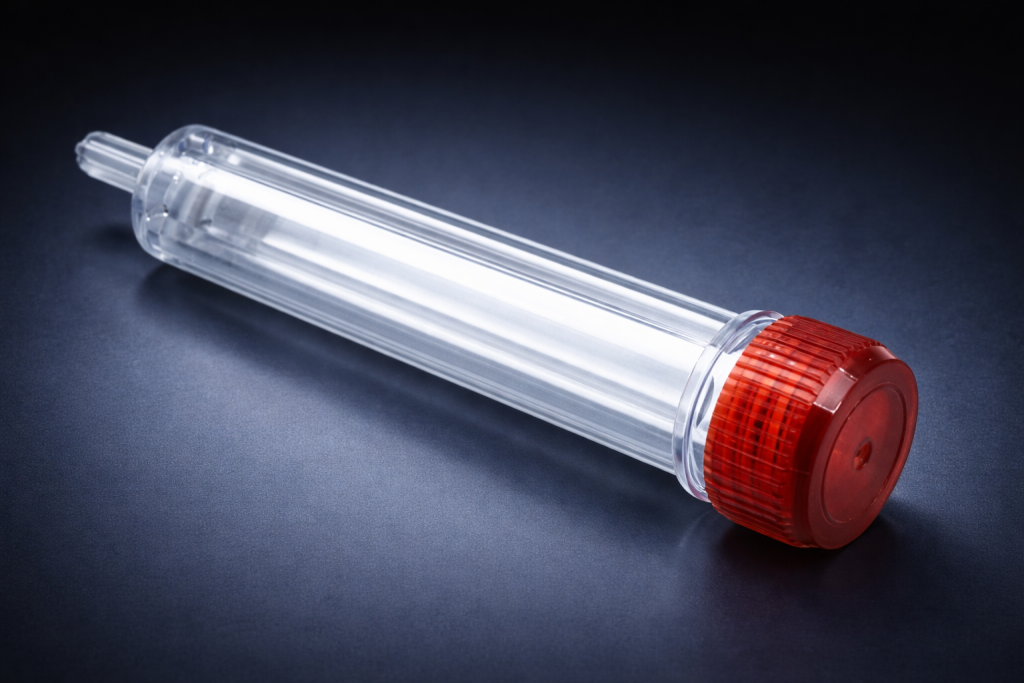
Surface finish isn’t just about aesthetics. In the medical industry, it’s closely linked to performance. Many medical and biopharmaceutical devices must be clear and smooth. CNC machining produces precise shapes, but it may leave marks or give some plastic parts an opaque finish.
This is when vapor polishing plastic steps in. Vapor polishing is a post-processing technique that can improve surface finish and, in certain materials, create a transparent, glass-like appearance. In this post, we will explore the method—how it works, why it’s important for critical industries—and how our approach improves consistency and safety.
What is Vapor Polishing?
Vapor polishing is a method of smoothing plastic surfaces, at microscopic levels, to create a smooth, contaminant-free, and transparent finish. A solvent vapor creates a controlled melt that flows easily over tool marks and imperfections. Although some of the benefits of vapor polishing plastic include optical clarity, its wider application goes far beyond aesthetics.
Let’s explore some of these benefits for medical devices.
Why It Matters for Medical Components
High-stakes industries require clear visibility and reliable performance from their components.
Vapor polishing offers several functional advantages:
- Internal Visibility: Improves transparency for viewing internal features such as fluid pathways.
- Improved Fluid Flow: Reduces microscopic surface roughness, helping minimize friction.
- Cleanliness: Smoother surfaces are less likely to trap contaminants and are easier to clean
The EPTAM Difference: Safety and Automation
There are other ways to do vapor polishing. Some manufacturing firms set up manual Bunsen burners, to boil flasks of MEK (methyl ethyl ketone). Although effective, the MEK method is volatile, flammable, and extremely hazardous. We took a different path.
EPTAM utilizes a non-flammable and non-hazardous solvent. We moved away from dangerous manual methods, to create a fully automated solution.
Our system is a continuous loop. Liquid solvent is boiled into a gas, before rising into a controlled “vapor zone.” After polishing, the vapor rises before phasing back into a liquid, finally draining into the sump. This system is fully enclosed. This closed-loop process improves consistency, reduces exposure, and creates a safer working environment—while still delivering a high-quality surface finish
We designed this system to handle multiple parts, ranging up to twelve inches in diameter, ensuring we can safely and effectively polish products of varying sizes.
Materials We Shine With
Certain materials respond better to vapor polishing than others.
Polycarbonate Vapor Polishing
Polycarbonate is a tough material. When vapor-polished, it achieves optical clarity comparable to that of glass. Polycarbonates are ideal for viewing windows and high-stress medical housings.
Acrylic Vapor Polishing
Acrylic is susceptible to clouding. Vapor polishing restores its natural transparency. Acrylics are used for lenses, guides, and aesthetic covers.
How We Ensure Consistency
Consistency is what separates precision manufacturing from more variable processes. Manual polishing depends heavily on operator technique, which can lead to inconsistent results.
At EPTAM, we use a servo-driven, automated system to control the process. Key parameters—such as fixturing angle, exposure time, and temperature—are defined and validated for each part.
Once optimized, those settings are repeatable. The operator loads the parts, and the system executes the process consistently every time. This allows us to efficiently polish multiple parts within a controlled vapor zone while maintaining uniform results.
Our equipment can polish multiple parts within seconds, inside a vapor zone volume of 40” x 12” x 20”.
Conclusion
Vapor polishing plastics—particularly for medical devices—can enhance both functionality and surface quality. When applied to the right materials, it improves clarity, reduces surface imperfections, and supports overall performance.
By moving to an automated and controlled process, we improve consistency, reduce reliance on hazardous manual methods, and create a safer working environment.
Ultimately, our goal is simple: deliver high-quality parts that meet the demands of critical medical applications. When vapor polishing is the right fit—especially for materials like polycarbonate—our process is designed to deliver reliable results, every time.