
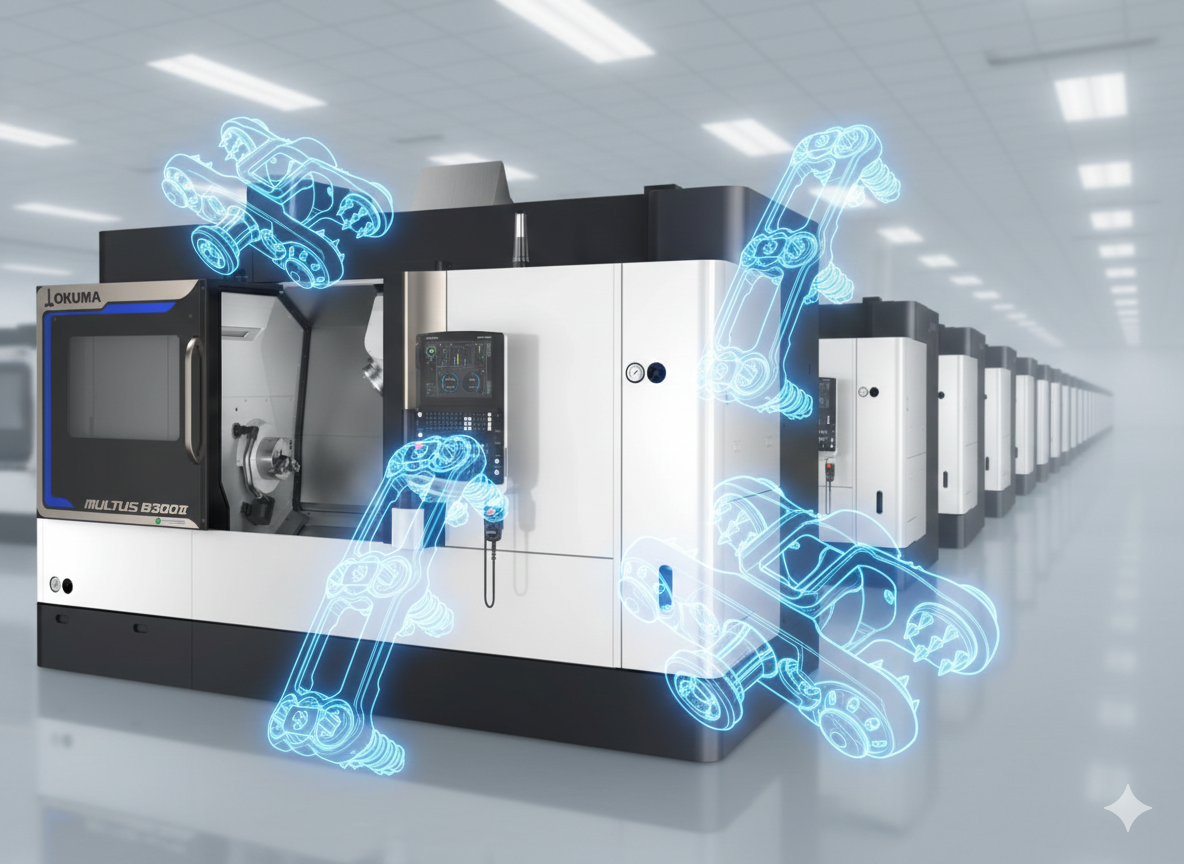
To produce the complex parts needed in the medical device industry, the journey of product development – from raw material to finished item – is difficult. Multiple machines, setups, and manual tweaks are often required. It can be a time-intensive and costly process.
Advanced technology has now simplified those systems. In this post, we’ll explore 7-axis CNC machining, through a powerful device: Okuma Multus. We’re going to analyze what makes the technology so effective when dealing with complex metal medical components.
What is an Okuma Multus?
Okuma Multus is a state-of-the-art CNC (Computer Numerical Control). Multus specializes in streamlining production tasks. Instead of needing one machine for turning (lathing) and another for milling (cutting and shaping), Multus combines these functions – and more – into one operation. It’s this multitasking which makes 7-axis CNC machining revolutionary.
A single, unified setup removes unnecessary logistical complexity. Multus takes away the need to constantly move parts between different machines. Lead times are reduced, as is the need for outdated part handling. A consolidation which results in higher output, less room for error and, ultimately, more cost-effective metal CNC parts.
Okuma Multus streamlines production processes. EPTAM houses one of the largest fleets of Multus turn-mills in the Northeast, with several lines of the Okuma Multus 300-II models in our facilities. This empowers us to tackle demanding projects with precision. Multus is a single-machine solution, which offers superior quality, whilst maximizing efficiency for critical industries.
The Capabilities of 7-Axis CNC Machining for Complex Medical Components
Okuma Multus is an all-in-one machine, with multiple configurations, all applicable to complex medical part machining. Multus can handle a range of part sizes. This versatility is unique to the Multus, making the creation of conforming parts practical and effective.
They hold a 10-inch chuck, but larger sizes are available. The maximum turning diameter is 24 inches with a maximum turning length of 35 inches. With a multi-axis movement, Multus’s milling spindle can create a suite of intricate shapes and features. On less-advanced machinery, this would be impossible to replicate.
Our Multus machines can hold up to 60 tools. As a “done-in-one” process, no manual labor is required during the cycle. Parts can be transferred – automatically – from one spindle to another, allowing for a seamless process. And, by automating measurements and adjustments, laborious setups instead become smooth processes.
The Key Benefits of Multitasking CNC Machining
Before multitasking machines – like Okuma Multus – producing parts involving complicated geometries was slow and expensive. Consolidating tasks, into an all-in-one solution, is a reliable way to enhance efficiency whilst saving on costs.
Let’s explore some of these key benefits in greater detail:
- Reduced Lead Times and Costs
With Multus, turning and milling functions are accomplished in one slick operation. With no need for secondary setups, production time is reduced, as are the expensive and labor-intensive costs of additional setups.
- Enhanced Precision and Quality
Small errors compromise tight tolerances. CNC machined medical components must be highly accurate. One setup means the part can be completed in a single clamping – minimizing the risk of non-conforming.
- Minimized Waste and Production Risk
Consolidating tasks limits errors. Multus creates less waste, reducing the likelihood of non-conforming parts. And with integrated collision-avoidance features, Multus is able to anticipate and correct operator errors – creating a safer working environment.
Conclusion
From surgical instruments to orthopedic implants, EPTAM is committed to creating high-quality metal medical components. Using 7-axis CNC machining, intricate metal medical components are produced with unmatched precision. Using Okuma Multus, we bring complex designs to life. We not only make parts faster; we make them better.