
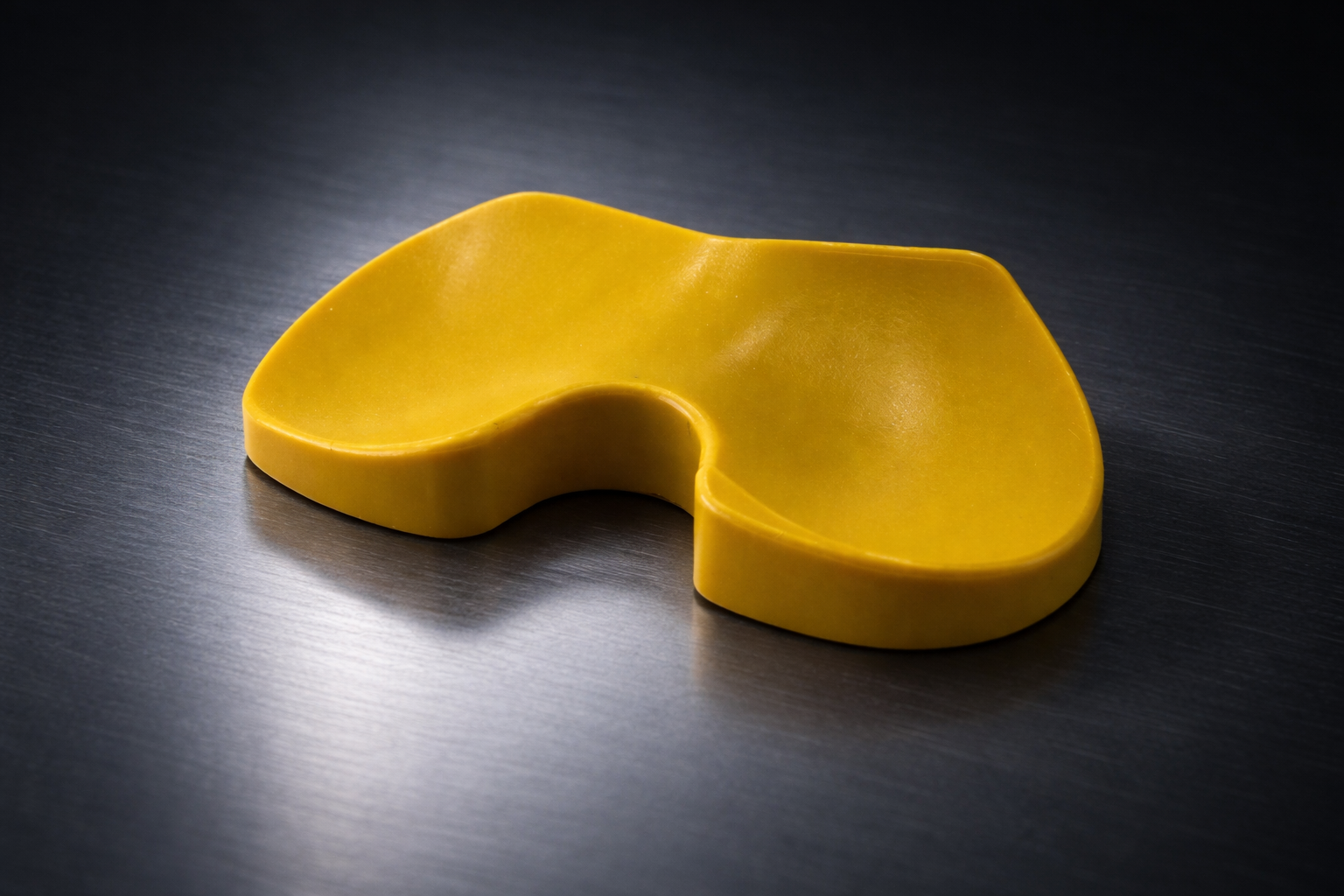
Advancing the Future of Joint Replacement
Technology often gets the spotlight in modern medicine—but some of the most meaningful breakthroughs come from the materials themselves. One of the most important? Ultra-High Molecular Weight Polyethylene (UHMWPE).
In this post, we explore how UHMWPE enables high-performance orthopedic implants—and how Vitamin E stabilization is redefining durability and long-term outcomes in total joint replacement.
What is UHMWPE?
Ultra-High Molecular Weight Polyethylene (UHMWPE) is a specialized thermoplastic known for its extremely long molecular chains, which deliver:
- Exceptional wear resistance
- High impact strength
- Low friction characteristics
- Proven biocompatibility
These properties make UHMWPE a gold-standard material for orthopedic implants. However, transforming UHMWPE into precision medical components isn’t simple. The material requires significant compression forces and specialized machining expertise to achieve final form. At EPTAM, we partner with leading material suppliers and use advanced multi-axis precision machining to produce complex, tight-tolerance UHMWPE components for critical medical applications.
The Vitamin E Advantage
While UHMWPE performs exceptionally well, it has historically faced one key challenge: oxidation over time. Oxidation can occur during sterilization or throughout the implant’s lifecycle, potentially leading to material degradation and reduced performance.
The solution? Vitamin E stabilization.
Vitamin E acts as a powerful antioxidant within the material, helping to:
- Prevent oxidative degradation
- Maintain mechanical integrity over time
- Extend implant lifespan
The result is a more stable, longer-lasting implant material—particularly valuable in high-demand applications like hips, knees, shoulders, and ankles. For patients, this means improved durability, fewer complications, and a reduced likelihood of revision surgeries.
From Industrial Plastic to Medical Breakthrough
UHMWPE wasn’t originally developed for healthcare. First polymerized in the 1950s, it was used in industrial applications like conveyor systems and wear surfaces. Its transition into orthopedics came in the early 1960s, when Sir John Charnley introduced it in hip replacement procedures. From that point forward, UHMWPE became the benchmark material for joint replacements. Today, innovations like cross-linking and Vitamin E infusion are pushing performance even further—extending implant longevity and improving patient outcomes.
Precision Machining for Critical Applications
UHMWPE presents unique machining challenges. While it offers strength and stability, it also requires tight process control to maintain dimensional accuracy and consistency.
EPTAM specializes in:
- Multi-axis precision machining for complex geometries
- Automated inspection systems, including CMM and vision systems
- Process capability studies to ensure repeatability and control
Every component is manufactured with the understanding that there is no margin for error—because every part directly impacts patient outcomes.
Meeting Growing Demand in Orthopedics
Demand for high-quality orthopedic implants continues to rise.
Even during recent slowdowns in elective procedures, production volumes remained strong. EPTAM alone has manufactured over 15,000 ankle implant components for a single customer since 2020, demonstrating both scalability and consistency. As the market accelerates, the need for reliable, high-performance materials and precision manufacturing partners will only increase.
Conclusion: Built for Longevity. Designed for Life
Behind every implant is a patient seeking mobility, comfort, and independence. By combining advanced materials like Vitamin E-stabilized UHMWPE with precision manufacturing expertise, we help OEMs deliver implants designed for long-term performance.
At EPTAM, it’s not just about making parts—it’s about improving quality of life through precision, consistency, and innovation.